
Overview
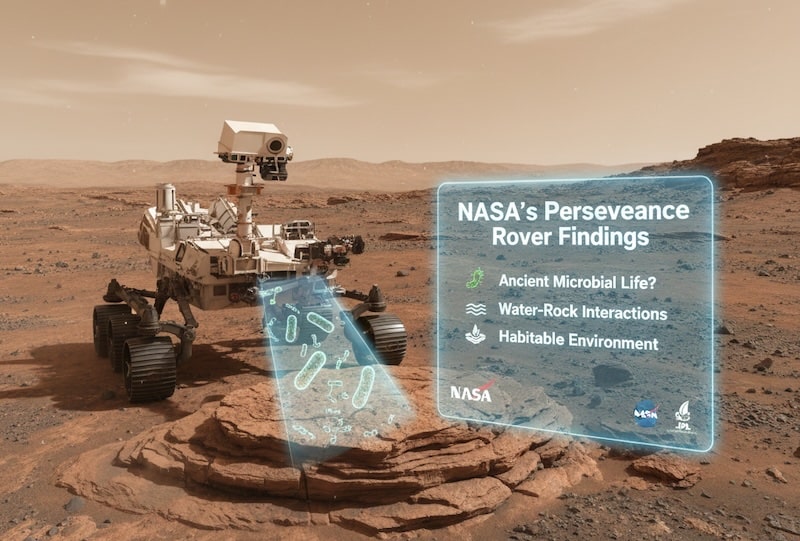
NASA’s Perseverance Mars rover has been exploring Jezero Crater since its landing in 2021, focusing on the search for signs of ancient life. Recent findings from a rock sample suggest potential evidence of microbial activity, although alternative nonbiological explanations exist.
Key Discoveries
Sample Details: The newly analyzed sample, known as the Sapphire Canyon sample, was collected from the Bright Angel rock formation, which consists of sedimentary rocks formed billions of years ago in a lake environment.
Minerals Identified: Two minerals, vivianite (an iron phosphate) and greigite (an iron sulfide), were detected in the sample. These minerals are often associated with microbial activity on Earth, as they can form through chemical reactions involving organic matter.
Research Insights
Potential Biosignature: The presence of vivianite and greigite may indicate past biological processes, as they typically result from interactions between organic matter and chemical compounds in mud.
Caution in Interpretation: Joel Hurowitz, a planetary scientist at Stony Brook University and lead author of the study published in Nature, emphasized that while these findings are intriguing, they cannot definitively confirm biological activity. Nonbiological processes could also produce similar mineral formations.
Geological Context
Historical Mars: Mars was once a wetter planet with liquid water, particularly in the Jezero Crater, which likely hosted a lake over 3.5 billion years ago. This environment could have supported microbial life.
Sample Collection: The Sapphire Canyon sample was obtained in July 2024 from rocky outcrops near Neretva Vallis, an ancient river valley that contributed to the lake’s formation.
Future Research Directions
Further Analysis: The findings provide a new avenue for research into potential biosignatures on Mars. Future studies will aim to establish whether these mineral formations were indeed produced by biological activity or if they are the result of nonbiological processes.
Sample Return Mission: The Sapphire Canyon sample could be analyzed further if returned to Earth, allowing for more comprehensive testing to determine its origins.
Conclusion
The Perseverance rover’s recent findings contribute significantly to our understanding of Mars’ geological history and the potential for past life. However, further research is necessary to confirm the biological significance of the found in the Sapphire Canyon sample.