Overview
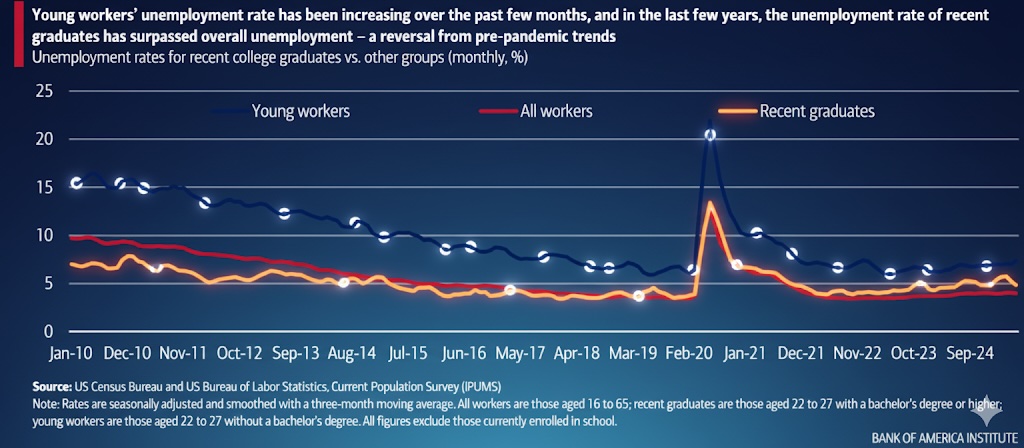
The unemployment rate for recent college graduates in the United States has now exceeded that of the overall workforce, marking a significant shift from pre-pandemic labor market trends. This analysis comes from the Bank of America Institute and highlights the challenges faced by young job seekers in the current economic climate.
Historical Context
For much of the last decade, individuals aged 22 to 27 with at least a bachelor’s degree experienced lower unemployment rates compared to the broader workforce.
Post-Pandemic Shift
Since the onset of the COVID-19 pandemic, this trend has reversed. Recent graduates have faced consistently higher unemployment rates than the national average, with the national unemployment rate reaching 4.2% in July 2025, while recent graduates experienced even higher rates.
Challenges for Gen Z
The report indicates that over 13% of unemployed Americans in July were new entrants—individuals seeking jobs for the first time, predominantly from Generation Z. This marks the highest level of new entrants in nearly four decades, indicating significant challenges for younger job seekers.
Economic Factors
The report links the bleak employment outlook for recent graduates to several macroeconomic factors:
Rising Global Trade Tensions: These tensions are contributing to a cooling labor market.
Automation and AI Integration: The rapid adoption of automation is eroding entry-level job opportunities, disproportionately affecting younger applicants and those with limited work experience.
Methodology and Data Insights
The findings are based on a combination of data from the U.S. Census Bureau and the Bureau of Labor Statistics, along with proprietary transaction analyses from Bank of America. The unemployment rates reported are seasonally adjusted and focus on individuals not currently enrolled in school.
Current Job Market Reality
Despite a relatively stable national unemployment rate, recent college graduates are facing unprecedented challenges in finding employment. A study by Goldman Sachs corroborates this by noting that the “safety premium” associated with having a college degree is diminishing. Additionally, research from Stanford University indicates that AI is having a significant and disproportionate impact on entry-level workers.
Conclusion
The analysis from the Bank of America Institute reveals a concerning trend for recent college graduates in the U.S. labor market, highlighting the need for strategies to address the unique challenges faced by this demographic amidst evolving economic conditions.